We do all guitar repair, restoration, refinishing and setup work as well as pick up rewinds and amp and pedal electronics repairs. If it's broken or not playing like it should, we'll fix it.
The retail shop stocks and sells a full range of hardware, leads, strings etc and we have exclusive dealerships so check out the pricelists for the best prices around.

Tym guitars blog has moved


Tym guitars has a brand new website up and running with the new BLOG as part of the site. Please go to Tym guitars to view/comment and browse the BLOG.


August 10, 2010

The P-90 pick up

This is one of my favorite pick ups for guitar after the Mosrite single coil. It has the clarity of the "Fender" single coil with the punch of the humbucker. Being a single coil design the tone of a P-90 is somewhat brighter and more transparent than a humbucker, though not quite as crisp and snappy as Fender's single coil pickups. The tone therefore shares some of the single coil twang, but having large amounts of midrange and often described as brisk. Popular guitars that use/have the option of using P-90s are the Gibson SG, Gibson Les Paul, and the Epiphone Casino. The pickups used in the Fender Jazzmaster are often confused with the P-90, however their only similarity is cosmetic since there are many significant visual, dimensional and electrical differences.
All vintage P-90 pickups are hand-wound, thus their physical specifications may vary slightly. In common with many other pickup types, there are two versions of P-90: neck and bridge version. Their DC resistance tends to be around 7-8 kΩ for neck pickups and 8-9 kΩ for bridge pickups. Earlier pickups (around 1952) used Alnico 3 magnets, but in 1957 Gibson switched to Alnico 5.
P-90 pickups were introduced in 1946 when Gibson resumed guitar production after World War II. They were originally used to replace the "bar" pickup (also known by many as the 'Charlie Christian pickup) on models such as the ES-150, and by the end of the 1940s it was the standard pickup on all models, including the Les Paul introduced in 1952.

The P-90's reign as the Gibson standard pickup was short-lived, however, as a new design of pickup known as the humbucker (occasionally named PAF) was introduced in 1957, and very quickly took over as the preferred choice for all Gibson models. The P-90 was then used on more budget models such as the ES-330, the Les Paul Junior and Special, and the SG Junior and Special, such as those used by Pete Townshend. This trend continued throughout the 1960s and particularly in the early 1970s where the pickup all but disappeared from the entire Gibson range. By the 1970s, single-coil pickups, mini-humbucking pickups and uncovered humbucking pickups began replacing the P-90 pickups on Gibson's budget and lower-end models.
In 1968, however, Gibson re-issued the original, single-cutaway Les Paul - one version of which was a Goldtop with P-90 pickups. In 1972, they produced Limited Edition reissues - the "58 Reissue" - actually based on the '54 Goldtop Les Paul, with a stopbar tailpiece; and the '54 Custom, the Black Beauty, equipped with a P-90 in the bridge and an Alnico 5 pickup at the neck - the total production of these guitars was quite small. In 1974, Gibson put the P-90 pickup in their Les Paul '55, a reissue of the Les Paul Special from that era. It was followed in 1976 by the Les Paul Special Double-cutaway model and in 1978 by the Les Paul Pro Deluxe. Since the 1970s the P-90 pickup has seen some success in various models in the Gibson line, mostly through reissues and custom versions of existing models.


One drawback of the P-90 pickup is its susceptibility to 50 Hz / 60 Hz cycle mains "hum" induced in its coil by external electro-magnetic fields originating in mains powered electrical appliances, motors, lighting ballasts and transformers etc. This susceptibility is common to all single-coil pickup designs, however the P-90 having around 2000 more turns of wire in its coil than Fender single coils produces a large amount of hum and for some players is objectionable enough to drive them to use side-by-side humbucking pickups instead. Several manufacturers now make hum-canceling pickups that share the form-factor of a P-90 and claim to have a similar sound. Obviously the arrangement of coils and magnets is different to the standard P-90, so the sound can never be an exact replica of the original.

August 9, 2010

EH Stereo Polychorus Analog Chorus/Flanger/Slapback Echo


EH Stereo Polychorus Analog Chorus/Flanger/Slapback Echo The final word in analog chorus pedals. The classic that Kurt Cobain and Adrian Belew relied on to create their signature sounds. The Stereo Polychorus provides the lushest stereo chorus, rich chiming flange, and the over-the-edge effects that made this versatile pedal legendary. Contact Tym guitars for more info and prices on all the EH range.

August 6, 2010

ToadWorks Mad Dog

ToadWorks Mad Dog is THE fuzz box of the new millennium - with it's snarling mids, hairy highs and low growl, Mad Dog rips the competition to shreds.

Priced to fit any budget, Mad Dog offers unparalleled tone and uncompromising quality, making Mad Dog the choice of professionals and amateurs alike.

All fuzzes are not created equally, and someone has to be the winner. Once you hear Mad Dog's bark, you'll beg for it's bite.

These pedals are IN STOCK now. Contact Tym guitars for more info and prices.

August 5, 2010

The Visual Sound One-Spot products

A 1 SPOT is the original 9V DC adapter that only takes up 1 Spot on an outlet strip or wall outlet. It solves an annoying problem that people have complained about for years!

* Only takes up ONE position on your outlet strip or wall outlet!!
* Handles from one to over twenty guitar pedals (1700mA max!)
* New heavy duty output cable!
* Use with optional multi-plug cable(s) for powering more than one pedal.
Guaranteed to work with any equipment that uses one of the following adapters (over 90% of the effects pedals on the market!):
* Boss PSA, Boss ACA, Danelectro DA-1, DOD PS-200R, Dunlop ECB-03, Ibanez AC-109, Korg A30950, Morley 9V, Zoom AD-0006.**
* With new converter plugs, the 1 SPOT will work with virtually ANY 9V pedal! ...even Line 6 modeling pedals! **
* Will even convert international voltage (100V-240V) automatically; no transformer needed!
* 3 meter (10') cable is almost twice as long as other adapter cable

3.5mm (1/8”) Converter

* Allows the 1 SPOT and MC5 cable to power Electro-Harmonix, older DOD, and other pedals that require a positive tip 3.5mm (1/8") plug


Battery Clip Converter

* Allows the 1 SPOT and MC5 cable to power anything that runs on a 9V battery


Reverse Polarity Converter

Allows the 1 SPOT and MC5 cable to power Yamaha keyboards, samplers, and drum machines, as well as certain reverse polarity effects pedals

August 4, 2010

New Tym guitar

OK folks. I started out in this game as a guitar builder. I don't call myself a luthier. Although I have built acoustics and semi solids, I mainly build solidbody electrics and I don't consider this the same as building acoustic instruments. Don't get me wrong, there's still a lot of skill involved, it's just not the same to me.
I have built over 100 guitars from scratch since 1997 but in the last few years I have only built 8 or 9 because of time restraints in keeping this THING that is Tym guitars alive. In a perfect would, I'd be left alone to make guitars full time, but it's not a perfect world, is it ?
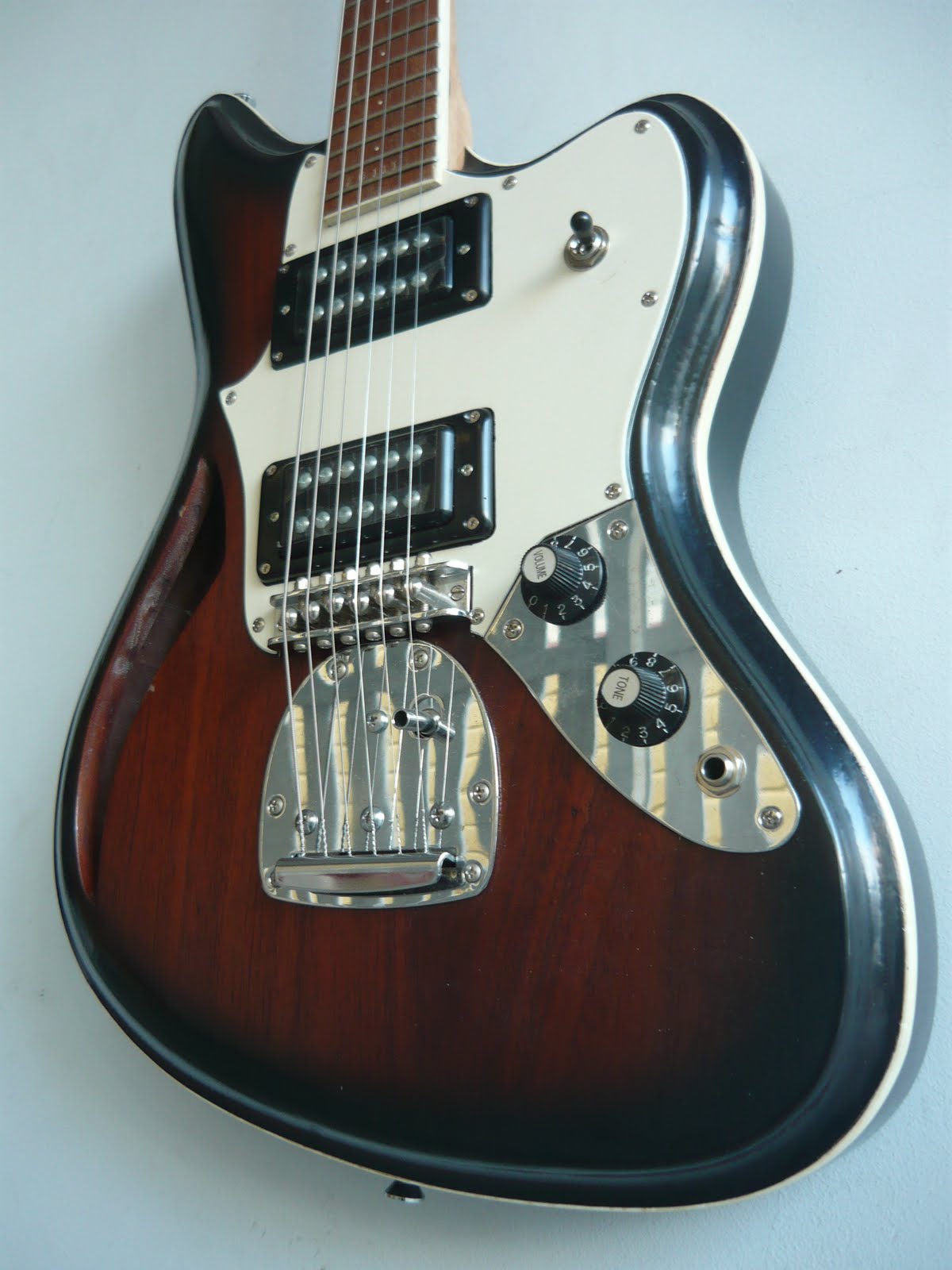
So I built this for my friend James from local band Violent Soho. I've been working with these guys for years and I "know" what James wanted in a guitar. He likes Jags, he likes hollow bodies, he likes Mosrite necks, he likes humbuckers, he likes the way a Les Paul feels when it's on, so, I put them all together and ..........

The body was made from a 100 year old mahogany desk top a friend gave me. He turned up at the repair shop one day and said "is this any good to you ?" Someone had cut the legs off it to make it a "coffee table" ? It was beautiful, but badly scratched BUT it was 100 year old mahogany, so I said YES !!!
Because it was thin, I decided to make a semi hollow, thick Jag body using three pieces sandwiched together with the middle piece cut out to give the chambers. That left the back and top to give the full depth. Since I was going to do binding and a German Carve ala Mosrite, I had plenty of thickness to work with. Once cutting all three pieces of the body it was glued and the binding channel routed. With the channel in place I start my German Carve. All of my guitars are made completely by hand. I don't have CNC's or jigs to do any of this. I prefer to do it all by hand and the German Carve is one of the most time intensive, yet rewarding parts of the Mosrite to me. I start with a router around the edge and then files and sandpaper to shape the carve. The German Carve isn't like an archtop, it changes depth and shape as it goes around the body. Deeper in some points, shallower in others. It's one of the reasons I love it so much. It makes a guitar body very organic looking. I also wanted a BIG slash style F hole that suited the shape of the body. I wanted the neck to go all the way back to the bridge pick up and be hollow underneath the neck to make it more "active" to neck feedback while still having controlable body feedback.
The neck is made from Victorian ash which I think has a very rock maple sound to it. Very stiff and hard. The fretboard is, like nearly every neck I've ever made, Jarrah. You REALLY need to "dry" it properly, but once dry it is a fantastic fretbaord timber. With the neck and body cut out it was down to shaping and working out what headstock shape to use.
I toyed with the idea of 3 a side in a Mosrite style, but ended up with a Bigsby inspired shape. As readers of my blog will know, I'm a huge fan of Bigsby and love this headstock. It suits "Fender" style guitar shapes really well because Fender was "influenced" by this shape to use on his guitars so we already have it in our minds. It has a double acting trussrod and like most of my guitars uses a zero fret. The neck has small dots in the Mosrite configuration and is bound. The neck is shaped straight off one of my '65 Ventures models so it's THIN all the way up but especially at the zero fret. The neck is attached with 3 screws from the back and 2 from the front with cut outs for the pick ups.

I used my Mosrite humbuckers in this guitar as James likes humbuckers and these are a little "biteier" than "normal" HB's as the pole pieces are all adjustable and slightly closer together.
Once the body and neck were shaped and finish sanded, it was into the spray booth for some coats of nitro finish. I didn't want to fill the grain or seal it in a synthetic coat and I don't mind the grain of the timber coming through into the top coat as it makes the guitar look like it's made of wood. So, it got a vintage black edge sunburst and then a few coats of clear nitro. The neck was done in nitro too.

So, with it painted and ready to assemble ......... it sat in my workshop for nearly a year before I had time to assemble it. I knew James was coming back from the US for an Australian tour in July so I had a deadline and got back into it again in June. It came together well and all that was left to do was work out a scratchplate shape for it. I tried a few different styles but ended up going for pretty much a Jag plate without the top chrome switch plate. The controls are, as you'd expect, 3 way toggle for pick up selector and master volume and tone control. It is 24.75" scale, so halfway between a Jag and a Jazzmaster. A standard Jag/JM vibrato was used but placed closer to the roller bridge to eliminate the problems associated with this set up.


The Ultraviolet 2

The Ultraviolet 2 is a four! channel fuzz with three active filter sections. From warm, rich distortion to densely layered, in-your-face wall of sound fuzz more dense than a lead brick! Not to mention the ability to tune the feedback harmonics and generate multiple discrete feedback harmonics at once. The UV2 splits your instrument signal into four separate channels, runs each through a separate fuzz channel and then through three active filter sections with one unfiltered channel which can be mixed in varying amount using the "mix" knob. Think of it as four! fuzz boxes and three differently voiced wah pedals all run in parallel. Near infinite sonic possibilities for insane fuzz audio terrorism!
Controls:
* Fuzz - Controls the overall amount of fuzz and gain. Dial in less fuzz for a cleaner, lower gain sound. Dial in more fuzz for a denser, more layered sound.
* Low Freq - Controls the center frequency of the low frequency filter section
* Mid Freq - Controls the center frequency of the mid frequency filter section
* Hi Freq - Controls the center frequency of the hi frequency filter section
* Mix - Controls the amount of signal from the unfiltered fuzz channel which is mixed back in with the other three (filtered) channels.
* Volume - Controls the overall effect output volume
This pedal is IN STOCK now. Contact Tym guitars for more info and prices.

August 3, 2010

BOSS TW-1 Touch Wah

BOSS TW-1 T Wah
The T stands for "Touch" and the early TW-1's actually had the text Touch Wah written on them instead of T Wah. The TW-1 was replaced by the AW-2 in 1991. Together with the CS-1, the TW-1 is the only pedal to have a toggle switch. With only 2 controls, the TW-1 is very easy to control. The later autowah pedals have the added versatility of modulation but for the basic wah sound the TW-1 does the job without forcing the user to read the manual.

Specifications
* Controls: Sens, Peak, 2-way Drive switch
* Connectors: Input, Output, AC Adaptor
* Current Draw: 6 mA (DC 9V)
* Recommended AC Adaptor: ACA Series
Labels
* Black - Made In Japan
The TW-1 was sold from July 1978 to May 1987.

We currently have an April, 1980 "silver screw" Touch Wah TW-1 in stock for sale. Contact Tym guitars for more info and price.

Diamond Bass Comp

IN STOCK NOW. The original Diamond Compressor has become one of our most well known products, loved by players for it's smooth response and ability to enhance your instruments tone. Turns out that bass players have discovered the Compressor (many via it's discussion on the TalkBass online forums) and while it generally works great for 4-string passive basses, the performance with 5/6 strings and high output active basses was less than ideal as the frequency response and headroom was optimized for guitar use.
Our response to that interest is the new dedicated Bass Comp, the first Diamond pedal designed specifically for bass players. With low frequency response extending down to 20Hz and increased headroom, the Bass Compressor is ideal for 4/5/6 string basses, both active and passive.
We've also revoiced the Tilt EQ control, offering bassists the choice of the original 900Hz tilt point or a new 250Hz setting, accessible via a mini toggle.
Features:
-Smooth, optical compression/limiting
-Premium audio components, including 2% polypropylenecapacitors,1% metal film resistors and a pro audio grade opamp (our signal path opamp alone costs 8 to 10 times
what the industry norm uses).
- Innovative 'tilt' EQ provides a very musical tailoring of frequency response - selectable 900Hz or 250Hz tilt point
- Dual AC capacitive coupling paths for improved
transient response.
- True bypass signal path
- 18V power supply included

August 2, 2010

Teisco May Queen, Vamper and Fire Bird.

I've always loved "cheap" (I use this term in the past tense) Japanese guitars that you could find at secondhand shops for great prices. Their shapes often made nearly every western manufactured guitar look so conservative and plain. They had points going the wrong way, lots of chrome and vibratos that look like you could have made a bridge out of. Sure, they were clunky, often hard to play and would feedback if you looked at your amps volume knob, but they looked (and sometimes sounded) so cool.

I had quite a collection of these type of guitars including my 2 favorites, Tiesco and Guyatone and was always fascinated with what else was "out there". Getting a copy of 60's Bizzare guitars by Rittor Music in Japan opened up a whole new world for me. I sat there and drooled over the shapes. I couldn't read the book, of course, it is in Japanese. There were so many, too many to get, but there, in amongst the pages and pages of weird guitars were 3 guitars released by Teisco in 1967/68 that I HAD TO have.

These Teiscos appeared at a significant time in Japanese guitar making. Teisco, which had formed following World War II as a Hawaiian guitar and amp company, had considerable success with exporting into the 1960s. They were probably the most successful brand during that decade. They made the fantastic Spectrum series. In January of 1967 they were acquired by Kawai, the piano company turned guitar maker. Kawai seems to have kept Teisco and its own lines separate throughout this period although in a lot of cases the same guitar could be bought with either brand name on the headstock, depending on what country you lived in.

Around this period the Japanese companies were feeling were getting more adventurous and more confident in their products and began to come up with original guitar designs. A whole spate of Japanese-style guitars appeared, reflecting creative thinking, not just copies of other people. This was, perhaps, the first golden age of Japanese guitars. All contributing to coolness.

The May Queen just stood out as a reject from the Rickenbacker factory that had been left in the sun to melt. This was first of the "set" that I got as they are probably the most common (out of these 3 anyway). These are semi solid construction with 1 F hole and an "organic" body shape that was very different from anything mainstream available at the time. These have been re-issued in recent years by Kawai and the re-issues are great, especially the top of the line version that has a copy of the original vibrato and pick ups. They are very Rickenbacker sounding even with the cheaper re-issue mini humbuckers.

Next I got the Vamper or the EV52-T. Obviously heavily inspired by Mosrite with a little Burns thrown in, these were offered in a few different versions and slightly later as a much "cut down" V2 version. I needed to have the one with all the bells and whistles and here it is. This is fully bound and inlayed, as top of the line Teiscos were AND has active electronics. The tone control sliders are essentially a sophisticated parametric EQ that is incredibly good and very quiet. The neck on this is AWESOME. VERY Mosrite with a thin but very comfortable profile. The pick ups have plenty of sparkle and bottom end especially with the tone shaping circuit on.

The last of the 3 to get was THE rarest of the rare. The AMAZING Fire Bird. These never took off and from what I've been told were dropped pretty quickly. This is a great guitar to look at and play. It is a full "thin line" hollow body and is very "lively" with another great neck. It is deceptively big with those incredible, evil horns. This is absolutely THE BEST shape EVER !!! These are HUGE and everything about them bucks the rules.

All three guitars hare have vibratos based on the Mosrite vibrato and work exceptionally well. I personally think it's the best vibrato design out there. These guitars were well made and NOT cheap pawn shop specimens as Teisco (and other great Japanese manufacturers) are lumped in with. Teisco made "cheap" entry level and student guitars, but these aren't amongst them. These, like the Spectrum series are every bit as good as any of the great Japanese factories that have produced guitars over the last 40 years. All were offered in bass versions and I assume these are even rarer. I have only ever come across 4 other Fire Bird guitars (all sunburst) and 1 bass. I have seen less than 10 Vampers in this version and of course have seen a few, original May Queens as they were the best selling of this series. How much are they worth ? Whatever a collector is prepared to pay, but mine aren't for sale, at least not for now.

August 1, 2010

Phoenix Custom Electronics SuperNova

Phoenix Custom Electronics' most versatile stompbox, the SuperNova is a silicon variation of the Fuzz Pedal. It's capable of some serious variation on the classic fuzz tones. You can get a clean sound by turning down your guitar's volume, and you can get overdrive by turning up the bias and backing off on the fuzz knob. Turning the bias knob down results in some really wierd, broken-amp type sounds. There is more gain available with this pedal than the Fuzz can give you, and also a bit more bite, but it can still get that smooth germanium sound as well. This pedal sounds closer to a germanium Fuzz than the typical Silicon Fuzz Faces of the late '60s and early '70s, which used much higher gain transistors than we use in the SuperNova. As of March 2006, the Range switch has been replaced with our new "Capacitor Blending" circuit which gives you a wide range of tonal options without sending signal to ground as a standard tone circuit would.
These pedals are IN STOCK now. Contact Tym guitars for more info and prices on all the Phoenix Custom range.